
Whether you’re taking piano lessons or teaching yourself, you’ll probably reach a stage where you’ll wonder if it’s worth it to learn how to read sheet music.
In short, it depends! You don’t necessarily need to learn how to read sheet music to play piano. But you do need some sort of way to remember and recall what you’re playing, and communicate musical ideas with others. In other words, you need ‘something’, but that ‘something’ doesn’t need to be music notation.
Let me explain!
Understand that playing music involves ‘encoding’ and ‘retrieving’
To play music, we need to learn two separate but related things:
- ‘Encoding’ a musical skill or idea – this is putting it INTO your brain. For example, learning a particular musical scale or a chord progression.
- ‘Retrieving’ a musical skill or idea – this is recalling what you need at a time you need it, like performing or songwriting or jamming with others.
This is a simple concept, but with music it very quickly becomes complex. A simple improvised exercise can involve melody, harmony, rhythm, expression, tone, and much more! Pianists need to consider things like finger numbers, touch, technique, pedalling. Then we need to remember the form, and know how many repeats and know when parts change. On top of that we have to listen to what we’re playing, assess how it’s sounding, make adjustments and remember these changes for next time.
It adds up real quick!
Understand that music theory is a shared language to describe sound
Music theory is a shared language to describe sound and how to create these sounds. Here I speak of music theory in the western music tradition. There are many music systems around the world, all with their own ways to create and describe sounds.
Music theory as a language is cultural, and continually evolves.
So when we learn to play music, we’re learning to describe and create the familiar sounds we’ve heard throughout time. And when we combine certain sounds in certain patterns, we get different genres and styles of music.
And much like any language, music can be taught and learnt and passed down in many ways; verbally/by ear, written and read with symbols and characters, by imitation and repetition, by performance and storytelling, by improvisation and communal music-making.
So you can see, there’s different ways to communicate musically besides music notation.
So what’s the point of music notation?
For me, music notation is one of many tools that we can use to remember and pass on music. Like the Great Library of Alexandria, writing music down has let us analyse and study it across generations.
And thanks to composers like Bach and Beethoven who wrote down the notes they played, we can still read and learn to play them 300 years later.
If you’d like to study music, especially at university or AMEB’s diploma levels, it’s integral to learn to read sheet music. But even for beginners and intermediate players, there are some nice benefits to reading music.
With sheet music, we can hone in on specific bars, we can start and stop at different points in the music, we can visualise the music while hearing it, and we can conceptualise complex parts while we’re still learning, without also needing to hold it in our fickle and limited working memory.
Best of all, we can leave a song and come back to it at a later date with sheet music.
When working with a lot of repertoire, I enjoy being able to pause on my thoughts and return to them easily with it written down in sheet music.
The downsides of reading sheet music
Notated sheet music is best read like a map; it gives you directions where to go and when to play. But like a map, if you never get your head out of it, you’ll never see the forest for the trees.
The biggest limit to sheet music is when players don’t look beyond the individual notes. Plus, staring obsessively at the page can cause errors like poor fingering, missing the keys, and stiff performances.
I also find when players solely use sheet music, they forget to train their aural memory. In that, they can’t remember how the song SOUNDS without the visual aid of music notation. This can cause great anxiety performance-wise as it leads to lesser note security.
Another down-side performance-wise, players focussing too much on sheet music tend to play note-by-note rather than lush long phrases. It’s also mentally taxing having to read every note, which limits performances greatly.
What are the alternatives to reading music notation?
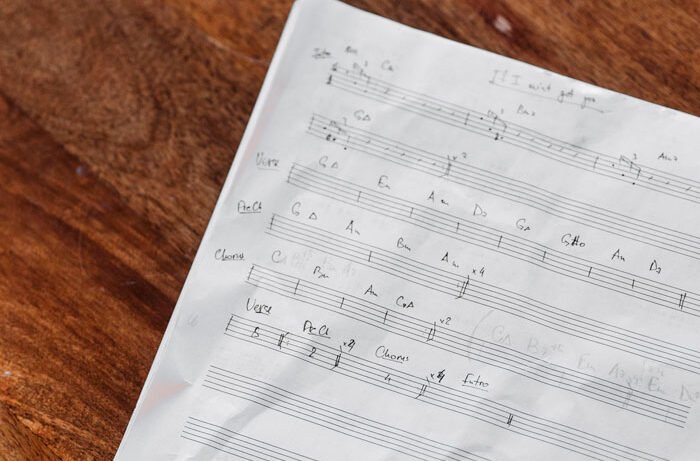
Chord charts
Often they’ll be paired with lyrics, with the chord names and symbols written above them.
Lead Sheets
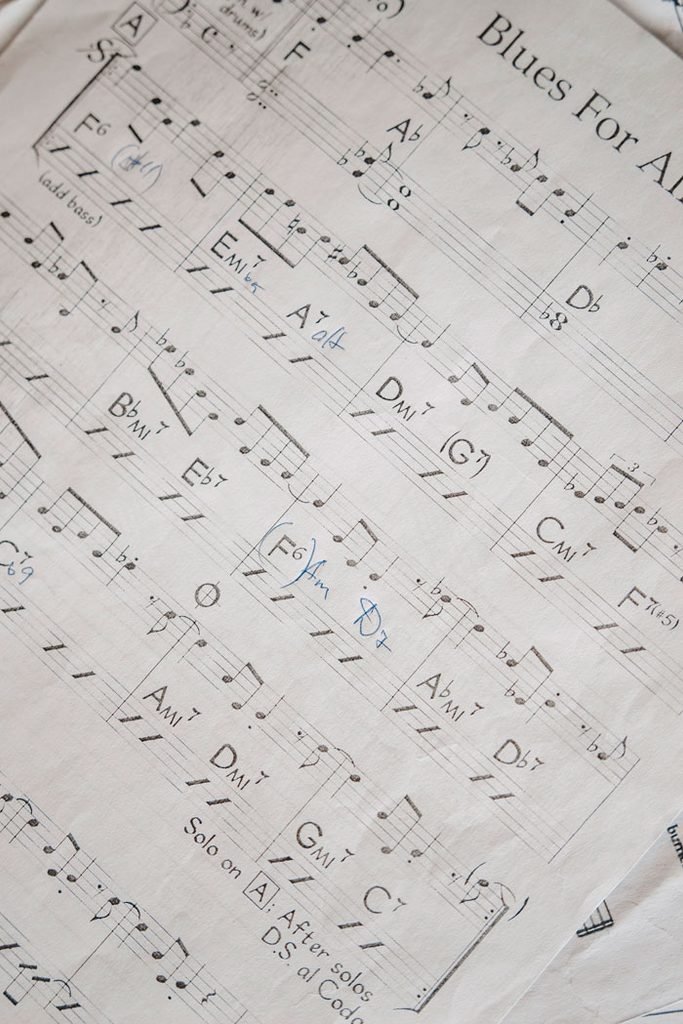
Many working musos use lead sheets, which only have a melody written down in music notation and chord names above them.
Lead sheets can also be a nice way for beginner note readers to get started with sight reading.
Examples of lead sheets are “Fake Books”, which are transcriptions of “jazz standards” and po pular piano music.
Pitch charts
Another is plotting out the pitch or melody shape of the music. This is drawn as dots that are plotted away or towards a middle line. The middle line is the song’s key center (what scale the song is based around), and the dots represent the pitch of notes in a melody. Chord symbols are also written underneath.
I love this method because it helps you see the rise and falls of melody as a shape or phrase, not individual notes.
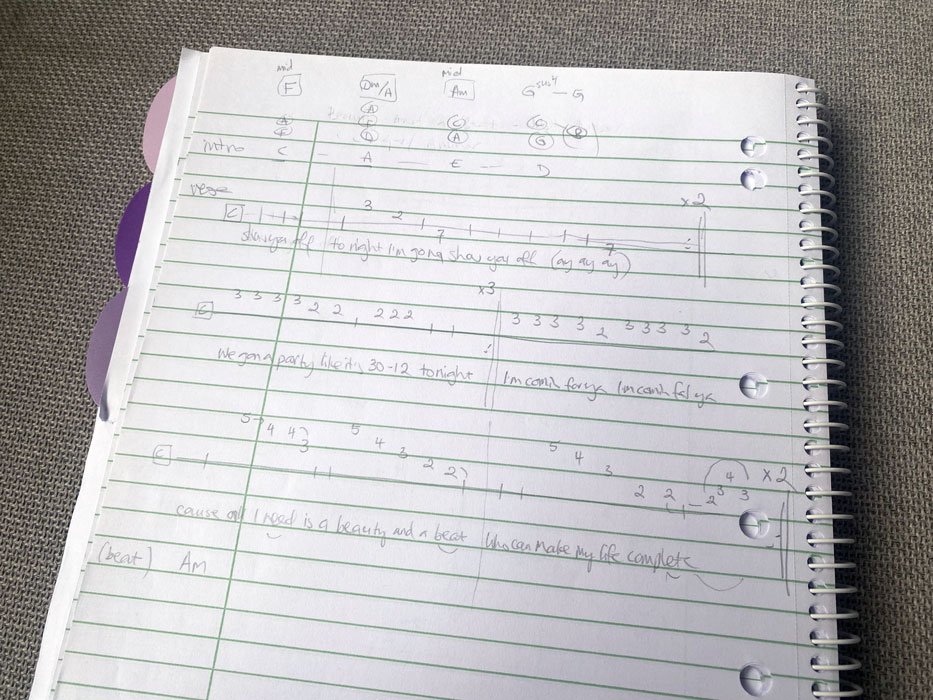
It’s also a helluva lot quicker to write out than music notes. Which makes it great for scribbling out ideas while songwriting or jotting down song transcriptions.
Songwriting software like Hookpad uses this type of music visualisation.
Piano “tabs”
Tabulature is another way of visualising music. Piano “tabs” can be seen in many YouTube videos with the keyboard at the bottom of the screen and dots falling down inline with which key needs to be pressed.
I like this method only for its accessibility. There are SO MANY piano videos and apps that uses this method, and they are cheap and easy to get started.
The downside to piano tabs is that it’s not very musical. It’s more like a game, where it only shows players how to move in one certain way. Much like Dance Dance Revolution where you have to hit the right buttons at the right time.
If there’s only one song you’d like to learn on piano, then I highly recommend using piano tabs. But if you’d like to learn music skills and play autonomously, I’d invest in learning music notation, lead sheets or pitch charts.
Ready to try a piano lesson?
So when should I learn to read sheet music?
I highly recommend learning to read music notation if you’d like to:
- Continue to study music at higher levels (university or AMEB Level 3 and Diploma levels)
- Play lots of repertoire
- Sight read and play new music on the spot
Chord charts and lead sheets are great if you’d like to:
- Play blues and jazz piano
- Improvise and jam with others
- Practice reading sheet music as a beginner
Pitch charts are awesome for:
- Songwriters who’d like to quickly sketch out ideas
- Transcription and learning to play by ear
- Learning scales and melody
Piano tabs are handy when:
- You have one specific song you’d like to learn and memorise
- You’re just starting out and like gamified learning
- You’d like to give piano a quick go before looking into lessons
Also, you don’t really have to commit to one or the other. Over the course of time, you might even come to learn all or none of these methods of notating music. The main thing really is to just get out there and play!

About the piano teacher
Michelle is a freelance pianist and piano teacher who aspires to make music fun and accessible for anyone who wants to play. She’s been playing and teaching piano to kids and adults for over a decade, and brings good vibes playing piano for weddings and events at Michelle Plays Piano.
Michelle also plays drums in post-punk and indie bands around Melbourne, and has written about bands for The Music and EARMILK. When she’s not obsessing over music, she’s probably thinking about food.

