Across my almost two decades as a kids piano teacher, I’ve had a great privilege of watchingI my students grow both as people and as musicians! The coolest part, is seeing the diversity of areas my piano students bring their music skills into! Far beyond just recitals and concerts, here are the 3 big life skills that I’ve seen kids learn and use IRL in every aspect of life.
#1. Lateral thinking (creative problem solving)
Hands down, music students become great problem solvers. That’s because every scale, chord, song learnt delivers an array of tiny problems to solve.
In music, there’s a hundred ways to play the same thing. And there’s a hundred different things all happening at once (left hand, right hand, rhythm, dynamics, melody, harmony…etc!). And the most interesting bit is that every student needs to come up with their own way to reach their solution.
No amount of “showing” will do, every music student must go through the “great struggle” of figuring it out. As piano teachers, we guide, offer advice based on our own experiences, imbue knowledge, communicate musically, entertain to engage, and give lots of encouragement to keep trying to figure it out.
One small example of problem solving in music lessons, is a teenage student of mine who needed to count a beat out loud and play but was struggling to do both at the same time. He came back the following week with his own solution; he changed the sound on his metronome app from a woodblock click to a voice that counted “1-2-3-4” to help him count while he played.
#2. Kids piano lessons teach Self-efficacy
Piano students aren’t shy people. Sure, there are students who prefer quieter modes of communication, or are reluctant about showing you what they’ve been working on. But certainly, all long-term musos have a quiet (or sometimes loud) belief in themselves to overcome challenging goals.
That’s because all long-term music students learn that ‘doing’ is the best way to learn and improve. They’ve also found ways to work through the platitude of inevitable errors and effectively learn from their mistakes. They’ve dealt with organising and simplifying complex information, and found the discipline to keep returning to their instruments to practice and play. They work towards long-term goals and perform regularly under pressure. They’ve spent years critiquing their own playing and engaging with critique from others. They’ve learnt to channel criticism constructively and have formed their own style and choices around their own playing. And furthermore, they’ve learnt to communicate and perform their choices with a clear purpose and intent.
All of this to say, that music lessons encourage skills for self-efficacy. Music playing is a great avenue for students to find their own path through the challenges they face.
One example, is a music student who had anxiety and nerves that would make them feel ill, signing themselves for a performance piano exam and performing well! (In the comments, the examiner commended them for their confident performance style, which they chuckled at but felt pleased about!).
#3. Learning to learn
Music lessons teach learning skills that can be applied anywhere. It’s no coincidence that many doctors and engineers in complex fields grew up learning music, and why top private schools consistently have music programs for students to learn an instrument.
Why music does this so effectively is that it one of very few things that can engage whole brain activity. Playing music taps into all areas of mechanical movement, cognitive reasoning, memory, executive functioning, nervous systems and so on! The connections between music lessons and neuroscience is truly fascinating.
In my piano lessons at Burger Chords, one of my goals is for all students to learn autonomous learning skills. That is, ways to not only learn in their music lessons, but also to be able to learn songs on their own outside of the classroom. In this way, students get to understand their own learning styles, learning needs, and strategies to remember and self-motivate. Naturally, it promotes inclusive learning across the neuro-diverse spectrum.
Ready to try a piano lesson?
Conclusion
In my mind, there’s no doubt that kids piano lessons can teach great life skills. And having taught adults and kids for two decades, and being a lifelong music learner myself, I sincerely believe that music education is not simply an extra-curricular activity, but a fundamental part of any child’s development and education.
So if you’re thinking about kids piano lessons in North Melbourne or wherever you are in the world, I hope your little one can give them a go!
About the piano teacher
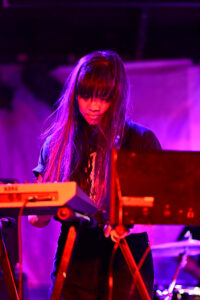
Michelle is a freelance pianist and piano teacher who aspires to make music fun and accessible for anyone who wants to play. She’s been playing and teaching piano to kids and adults for over a decade, and brings good vibes playing piano for weddings and events at Michelle Plays Piano.
Michelle also plays drums in post-punk and indie bands around Melbourne, and has written about bands for The Music and EARMILK. When she’s not obsessing over music, she’s probably thinking about food.